


Timing Belt Replacement in Houston: When to Schedule Service
Could your engine be at risk even while it runs smoothly? A timing belt can fail with little warning, and on an interference engine, a break may cause serious internal damage. If you’re searching for “timing belt replacement Houston,” plan service around your vehicle’s maintenance schedule, not just symptoms or guesswork.
It’s understandable to be unsure when service is due. Replacement intervals vary by make and model, and signs such as hard starting or sputtering can point to other engine problems too. Start with your owner’s manual for the correct interval. A technician can help interpret the schedule and assess what your vehicle needs.
This guide explains how the timing belt works, how it differs from the serpentine belt, and when replacement may be due. You’ll also learn what a timing belt service can involve and how to plan it with Fix My Car, an independent Houston repair shop serving the area for over a decade. ASE-certified technicians provide mechanical work, and free estimates and complimentary rideshare transportation can help make service day more convenient.
Table of Contents
Why Timing Belt Replacement Matters for Houston Drivers
A timing belt works behind the scenes, but its job is essential: it keeps engine parts moving in the correct relationship to one another. If the belt slips or breaks, what happens next depends on the engine’s design. Some failures can lead to internal damage; others may stop the engine without causing the same kind of piston-to-valve contact. Knowing your vehicle’s maintenance schedule helps you plan before a worn belt becomes an unexpected problem.
A timing belt synchronizes the crankshaft and camshaft so the engine’s valves can open and close in step with the pistons. That coordination supports normal engine operation, but the exact arrangement and service needs vary by vehicle.
What does a timing belt do inside an engine?
The crankshaft moves the pistons, while the camshaft controls when the valves open and close. The timing belt links their rotation so those movements stay coordinated. Think of it like musicians following the same beat: the parts perform different jobs, but they must stay in time. For a broader overview of the component and its role, see What is a Timing Belt?
Why can a broken timing belt become a serious repair?
In an interference engine, the pistons and valves occupy overlapping space at different points in their cycles. If a broken belt disrupts synchronization, they may collide and cause internal damage. A non-interference engine is designed with enough clearance to avoid that particular contact, though a broken belt can still leave the vehicle unable to run. The outcome depends on the engine, so don’t assume every vehicle faces the same risk.
A universal mileage rule can be misleading for this reason. A broad reference range sometimes used for timing belt replacement is 60,000 to 100,000 miles, but it isn’t a substitute for your manufacturer’s schedule. Some manufacturers also set a time-based interval because belt material can age even when the vehicle is driven less. Follow the recommendation for your exact year, make, model, and engine.
To find vehicle-specific guidance, start with these records and details:
Identify the vehicle’s year, make, model, and engine.
Check the owner’s manual and applicable manufacturer maintenance information for the belt interval.
Review service records to see whether the belt was replaced and when.
If the records are incomplete, don’t rely on a guess or wait for a warning sign. A belt may not provide an obvious signal before failure. A technician can use vehicle-specific service information to help assess the schedule and explain what maintenance is appropriate. For timing belt replacement Houston service, accurate vehicle details are a better starting point than mileage alone.
What a Timing Belt Replacement in Houston Can Involve
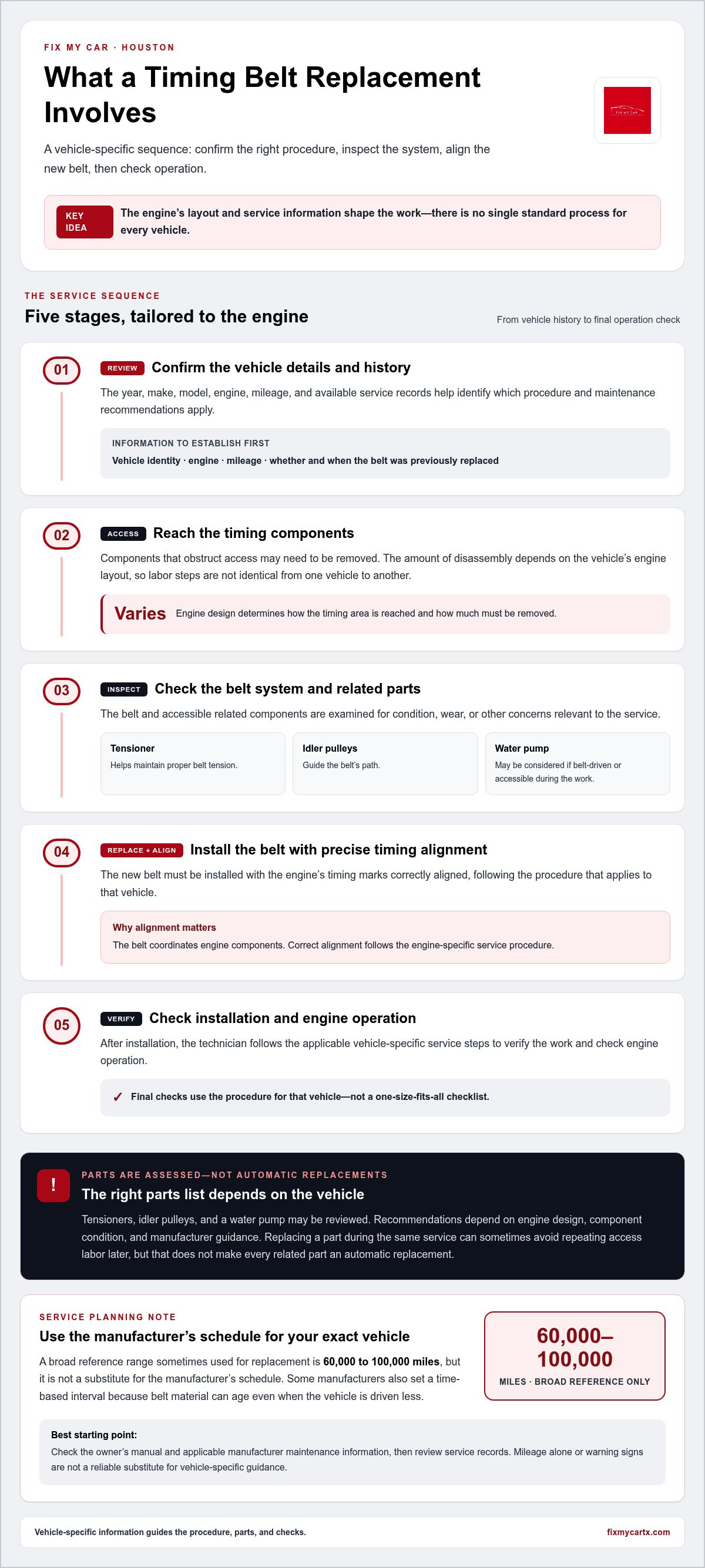
A timing belt service involves more than fitting a new belt. The technician needs to identify the correct procedure and parts for your engine, gain access to the timing components, inspect related parts, install the belt with precise alignment, and check operation afterward. The work can differ substantially between vehicles because engine layout affects how the belt is reached and how much must be removed.
A typical process follows a careful sequence:
Review vehicle details and records. The year, make, model, engine, mileage, and available service history help establish which procedure and maintenance recommendations apply.
Access the timing area. Components that obstruct access may need to be removed. The amount of disassembly depends on the vehicle’s design, so there isn’t one standard labor process for every engine.
Inspect the belt system. The technician examines the belt and accessible related components for condition, wear, or other concerns relevant to the service.
Replace and align. The new belt must be installed with the engine’s timing marks correctly aligned according to the applicable procedure.
Check operation. The technician follows the vehicle-specific service steps to verify the installation and engine operation.
Which components may be reviewed with the timing belt?
The tensioner helps maintain the belt’s proper tension, while idler pulleys guide its path. A water pump may also be considered if it is driven by the timing belt or is accessible during the same work. Replacing a component during a belt service can sometimes avoid repeating access labor later, but that doesn’t make every related part an automatic replacement. The right parts list depends on engine design, component condition, and manufacturer guidance.
Recommendations should be specific and explained. For example, a technician may assess whether the tensioner and pulleys are included in the manufacturer’s service guidance, and whether the water pump’s location or condition makes replacement appropriate. AGCO Automotive Corporation discusses belt service considerations in Why Timing Belt Replacement Matters. Your vehicle’s service information remains the guide for its exact procedure and parts.
How does a technician approach the replacement?
Before work begins, the technician reviews available maintenance history and engine-specific service information. During installation, timing alignment must be precise because the belt coordinates engine components. After installation, final checks follow the applicable procedure for that vehicle. These steps tailor the work to the engine instead of treating every timing belt job as interchangeable.
For a clear estimate, share your vehicle details and any service records you have. Fix My Car provides mechanical work in Houston, and its ASE-certified technicians use vehicle-specific information to guide timing belt recommendations. If you’re planning timing belt replacement Houston service, review the proposed work and estimate with Fix My Car’s timing belt service team. Complimentary rideshare transportation is available while vehicles are being serviced.
Timing Belt, Timing Chain, or Serpentine Belt: What’s the Difference?
These parts may all come up during engine service, but they don’t do the same job. A timing belt or timing chain synchronizes engine components, while a serpentine belt drives external accessories. Identifying which part your vehicle uses helps you find the right maintenance guidance and avoid mistaking one belt’s condition for another’s.
Does every vehicle have a timing belt?
No. Some engines use a timing belt, while others use a timing chain. The vehicle’s make or model year alone isn’t enough to identify the setup with confidence, since engine options can differ. Check the owner’s manual or vehicle-specific manufacturer service information using the exact year, model, and engine. Belt and chain maintenance recommendations aren’t interchangeable.
Is a timing belt the same as a serpentine belt?
No. A timing belt works inside the engine to keep its moving components synchronized. A serpentine belt runs externally and powers accessories. The belts have different functions, locations, and service guidance. A worn, noisy, or damaged serpentine belt doesn’t reveal the condition of an internal timing belt, which may not be visible during a basic under-hood check.
Use the comparison as a starting point, not a diagnosis. Look up your exact engine configuration and maintenance schedule, then compare that information with available service records. If the records mention a “belt” without naming which one, check the repair description rather than assuming it means the timing belt. Clear parts identification can prevent confusion when planning maintenance.
This distinction can also help you describe a concern accurately during a mechanical inspection. If an accessory stops working, the serpentine belt may be relevant; if you’re checking scheduled engine maintenance, verify whether the engine uses a timing belt or chain. For drivers researching timing belt replacement Houston service, vehicle-specific information is the most reliable way to identify the right component and plan the appropriate work.
How to Find Your Vehicle’s Timing Belt Service Interval
The right replacement schedule comes from your vehicle’s maintenance information, not a one-size-fits-all mileage estimate. Both mileage and time may matter, and the recommendation can vary with the engine. Timing belt replacement timing depends on the vehicle’s specified maintenance schedule. Use the steps below to find the guidance that applies to your car and make the most of its service records.
Gather your vehicle details. Write down the year, make, model, engine, and current mileage. If you’re unsure which engine it has, check your vehicle documents or identification information before looking up a schedule.
Start with the owner’s manual. Find the maintenance section and look for timing belt inspection or replacement guidance. Note any mileage or time condition the manufacturer specifies.
Review applicable manufacturer information. If the manual is unavailable or unclear, use maintenance information for your exact vehicle and engine. Avoid applying guidance from a similar model with a different engine.
Check service records. Look for an invoice or maintenance entry that identifies the timing belt and records when it was replaced. A general “belt service” note may refer to another belt, so read the description carefully.
Compare the schedule with your records. Consider the vehicle’s age as well as its mileage. If the replacement history is missing or uncertain, keep that in mind when planning a service assessment.
What information should you gather before scheduling service?
Have your vehicle details, current odometer reading, and any repair or maintenance records together. Note when the timing belt was last replaced, if you can establish that from an invoice. Also write down relevant dashboard warnings or changes in engine behavior. You don’t need to diagnose them yourself; clear observations help a technician understand the concern and use vehicle-specific information to guide the assessment.
Can symptoms tell you when a timing belt is due?
Not reliably. Timing belts are often concealed behind engine covers, so their condition may not be obvious during a routine visual check. Hard starting, unusual exhaust smoke, or sputtering can have different causes and don’t prove that the timing belt has failed or reached its scheduled interval. If your vehicle develops concerning symptoms, arrange a professional assessment rather than relying on symptoms to set the replacement date.
For timing belt replacement Houston planning, bring your records and vehicle details to the discussion. Fix My Car’s ASE-certified technicians use vehicle-specific information to guide service recommendations, and a free estimate can help you understand the proposed work. Schedule a timing belt service assessment with the details you’ve gathered.
Get Timing Belt Service from Fix My Car in Houston
Planning timing belt service is easier when the recommendation is tied to your vehicle, not a generic mileage estimate. Fix My Car provides mechanical work and timing belt service in Houston. ASE-certified technicians use vehicle-specific information to guide service recommendations, connecting the maintenance schedule, your service history, and the work your engine may need.
What to expect when you arrange service in Houston
Gather your vehicle’s year, make, model, engine, current mileage, and any available maintenance records. If you know when the timing belt was last replaced, include that information. Bring along relevant warning lights or engine symptoms too, without trying to diagnose their cause. These details give the service discussion a useful starting point and help keep the estimate focused on your vehicle.
The estimate should reflect your vehicle and the work recommended for it. Timing belt access and related components can differ by engine, so the proposed service may differ from a job on another car. Review the recommendation and ask for an explanation of the work included before deciding how to proceed. Fix My Car offers free estimates to help you understand the service plan.
How Fix My Car helps make the next step easier
Clear communication matters when a repair involves components that may be hidden behind engine covers. Fix My Car’s technicians can use vehicle-specific information to explain the service recommendation and help you understand how your records relate to it. Sharing what you know, including gaps in service history, supports an informed conversation. You don’t need to arrive with a diagnosis; your vehicle details and observations are a practical place to start.
Service-day transportation is another consideration. Complimentary rideshare transportation is available while your vehicle is being serviced, which can help you plan how to get around. The details of the repair and your vehicle determine the work involved, so review the estimate for the proposed scope.
If you’re considering timing belt replacement Houston service, gather your vehicle information and records, then discuss the service plan with Fix My Car. Request a free estimate for vehicle-specific timing belt service and the work recommended for your car.
Make Your Next Maintenance Decision with Confidence
You don’t need to wait for a warning light or unusual engine noise to start planning. Check your records, note what you’re unsure about, and use your vehicle’s maintenance guidance to frame a service conversation. That gives you a clearer basis for deciding whether timing belt replacement Houston service belongs on your maintenance plan.
Fix My Car is an independent Houston repair facility serving local drivers for over a decade. Its team includes ASE-certified technicians and manufacturer-certified technicians who can provide vehicle-specific mechanical recommendations. You can get a clear estimate and practical service-day support, including complimentary rideshare transportation while your vehicle is being serviced.
Start with the details you have, even if your maintenance history isn’t complete. A thoughtful assessment can help turn uncertainty into a plan tailored to your vehicle. Request a free estimate from Fix My Car and take your next maintenance step with confidence.
Frequently Asked Questions
Can I drive my car if the timing belt is making noise?
A new or unusual noise near the engine should be assessed promptly, but it doesn’t confirm the timing belt is the source. Other engine components can make similar sounds. If the noise is accompanied by rough running, warning lights, or a sudden change in performance, pull over somewhere safe and turn off the engine. Avoid continued driving until the cause is assessed, especially if you suspect a timing component.
What happens if a timing belt breaks while driving?
The engine may stop running, and the vehicle could lose power while you’re on the road. The extent of damage depends on the engine design: some engines can suffer internal contact between pistons and valves, while others may avoid that specific damage. If the engine suddenly stalls, move to a safe location if possible and don’t keep trying to restart it. Arrange professional diagnosis before driving again.
How much does timing belt replacement cost in Houston?
The cost depends on the vehicle’s engine, how difficult the timing area is to access, and which related components the manufacturer’s procedure calls for. A reliable estimate needs your exact vehicle details and the work recommended for it. Fix My Car provides free estimates for Houston drivers, so you can review the proposed service before deciding. Have your year, make, model, engine, and available service history ready.
Can a mechanic tell if a timing belt is worn without removing its cover?
A mechanic often can’t fully assess a concealed belt without following the vehicle’s inspection procedure, which may require removing a cover. A limited view, if available, may reveal visible wear or damage, but it may not show the belt’s full condition. Service records and mileage can help guide the assessment too. Ask what was inspected and whether the findings establish the belt’s condition or indicate a need for further inspection.
Does a timing belt replacement usually include the water pump?
Not in every case. Some engines have a water pump driven by the timing belt or positioned where access overlaps, so a technician may assess it during the job. Whether it belongs in the recommended work depends on the vehicle’s service procedure, pump condition, and manufacturer guidance. Review the estimate to see whether the pump is included and why it’s recommended, rather than assuming every timing belt service includes one.
How long does timing belt replacement take?
Service time varies with engine layout and how much work is needed to reach the timing components. The process may also involve related parts or additional findings, which can affect the work plan. Share your vehicle details when requesting an estimate so the shop can discuss the job for your specific engine. If your schedule depends on the vehicle, include expected service time in that discussion.
Can I replace a timing belt myself?
It’s possible for an experienced home mechanic with the correct tools and vehicle-specific service procedure, but this is a precision repair. The crankshaft and camshaft must be aligned correctly, and an installation error can prevent the engine from running properly or cause damage. Before attempting the job, assess your experience with engine timing and follow the manufacturer’s instructions for your exact engine. If that work is unfamiliar, professional service is the safer option.

Comentarios