


Car Transmission Repair in Houston: The Ultimate Driver’s Guide to Reliability
Imagine you're merging onto the I-610 Loop during rush hour when your engine suddenly revs, but your car doesn't accelerate. That sinking feeling in your chest isn't just about the traffic. It's the realization that your transmission might be failing in a city where your vehicle is your lifeline. We understand that searching for car transmission repair houston often feels like a high-stakes gamble. You're likely balancing the fear of high costs with the stress of being stranded without a ride in our sprawling metro area.
It's a heavy burden to carry, but you don't have to navigate it alone. This guide helps you identify early warning signs and explains how Houston's extreme heat and humidity impact your vehicle's health. We'll break down the technical jargon so you can distinguish between a minor adjustment and a necessary rebuild. By the end, you'll have a clear path toward a reliable diagnosis and a North Houston shop that treats you like a neighbor. We'll explore everything from diagnostic precision to the local maintenance factors that keep your car on the road longer.
Table of Contents
Understanding Your Car’s Transmission: The Houston Heat Factor
Your car's transmission is essentially the gearbox that takes raw power from the engine and delivers it to the wheels at the appropriate speed. It's a complex piece of machinery that ensures your vehicle moves efficiently, whether you're merging onto a highway or idling at a red light. Understanding how an automatic transmission works helps you appreciate the hundreds of moving parts that must sync perfectly to keep you moving through Houston traffic. Without a healthy transmission, that engine power has nowhere to go, leaving you stranded.
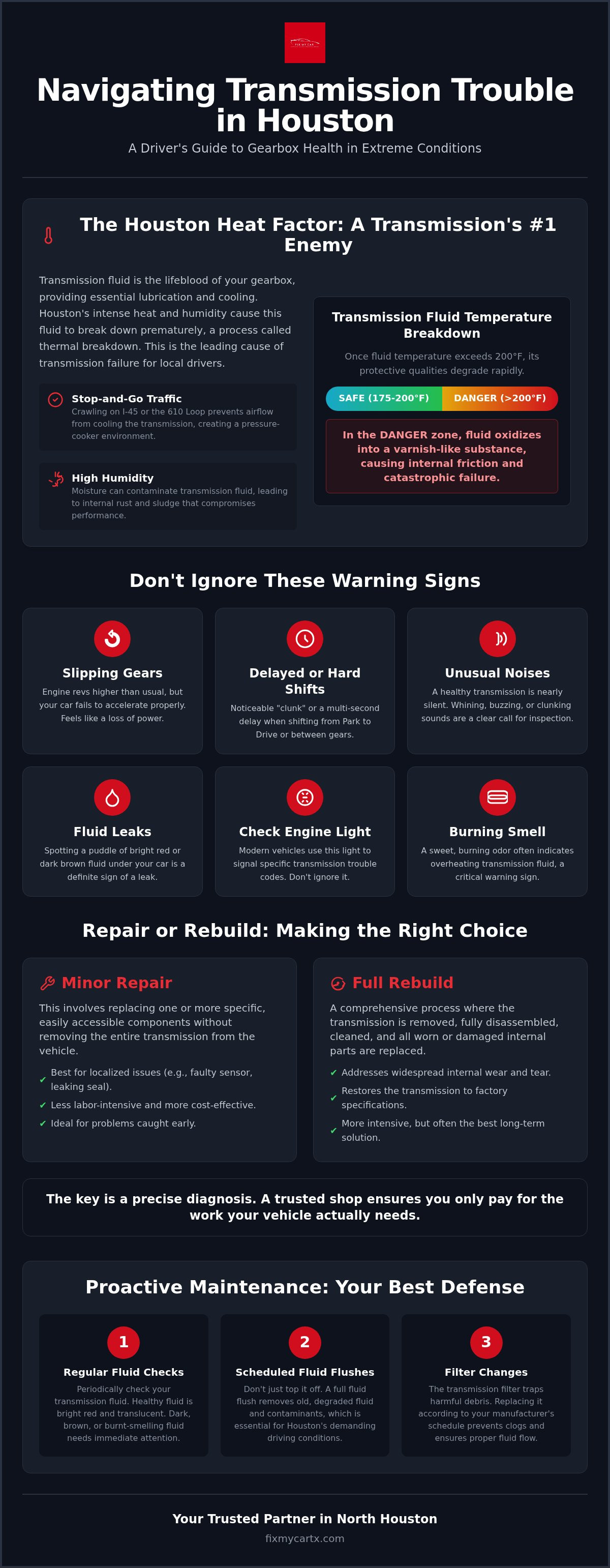
Transmission fluid is the lifeblood of this entire system. It performs two critical roles: lubrication to prevent metal-on-metal friction and cooling to dissipate the massive amounts of heat generated during operation. In our local climate, this fluid works significantly harder than it would in cooler regions. Thermal breakdown occurs when extreme heat causes transmission fluid to lose its chemical properties, effectively "cooking" the liquid until it can no longer protect the gears or maintain hydraulic pressure. For local drivers, this is the leading cause behind the need for car transmission repair houston.
Houston's infrastructure adds another layer of stress. Crawling along I-45 or the 610 Loop in stop-and-go traffic prevents consistent airflow from passing over the transmission cooler. This lack of natural cooling, combined with the constant shifting required in heavy traffic, creates a pressure cooker environment. This environment accelerates wear and tear on internal seals and clutches, making proactive monitoring essential for any North Houston commuter.
The Science of Transmission Fluid and High Temperatures
Most transmissions are designed to operate at temperatures between 175 and 200 degrees Fahrenheit. Once the internal temperature climbs above that 200-degree threshold, the fluid begins to oxidize and turn into a varnish-like substance. This leads to a total loss of viscosity. When the fluid becomes thin and watery, it can't provide the protective barrier needed to stop internal friction. Additionally, Houston’s notorious humidity can contribute to fluid contamination. Moisture can enter the system through vent tubes during rapid temperature changes, leading to internal rust and sludge that compromises your vehicle's reliability.
Automatic vs. Manual: Different Needs for Houston Roads
While automatic transmissions are the standard for most modern SUVs and trucks in Texas, they are highly dependent on hydraulic pressure and fluid health. Continuously Variable Transmissions (CVTs) are particularly sensitive to high-heat zones. They use a belt-and-pulley system that requires specific friction coefficients to function; if the fluid isn't pristine, the belt can slip and cause permanent damage. Manual transmissions face different struggles. The constant "creep" of heavy traffic leads to excessive clutch wear, as the friction material is repeatedly engaged and disengaged. Whether you're driving a heavy-duty work truck or a compact commuter, the Houston heat doesn't discriminate between transmission types.
Common Signs You Need Car Transmission Repair in Houston
Catching a problem before it leaves you stranded on the Westpark Tollway can save you thousands of dollars in long-term damage. Many drivers wait until their vehicle stops moving entirely, but your car usually provides several subtle warnings first. If you notice your engine revving higher than usual while the car fails to gain speed, you're likely experiencing slipping gears. This is a classic indicator that you need a professional evaluation for car transmission repair houston. Similarly, feeling a physical "clunk" or experiencing a multi-second delay when moving from Park to Drive indicates that internal hydraulic pressure is failing to engage the gears properly.
Unusual noises often accompany these physical sensations. A healthy transmission should operate almost silently. If you hear whining, buzzing, or a rhythmic clunking coming from beneath the floorboards, it's time to investigate. While a "Check Engine" light might seem unrelated to your gearbox, modern vehicles use this generic warning to signal specific transmission trouble codes. Understanding your consumer rights for car repair ensures you can ask the right questions when these dashboard lights appear, protecting both your vehicle and your wallet.
Fluid Leaks: The Red Warning Sign
Healthy transmission fluid is a translucent, bright red liquid with a slightly sweet smell. If you spot a puddle under your car that looks like dark cherry juice, you have an active leak. Over time, the intense Houston heat causes this fluid to turn a muddy brown or black color, often smelling like burnt toast. Leaks usually occur at the pan gasket, front seal, or along the cooler lines. Because the transmission is a closed system, even a small leak leads to low fluid levels. This is the primary cause of catastrophic gear failure for many local drivers. Checking your driveway regularly is the simplest way to avoid an unexpected breakdown.
The Role of On-Board Diagnostics
Modern vehicles are equipped with sophisticated sensors that monitor internal pressure and temperature in real time. These sensors often detect a problem before you feel a single slip or shudder. Utilizing professional car diagnostic services in Houston allows technicians to read these specific error codes and pinpoint the exact solenoid or sensor that's failing. Simply clearing the code without addressing the root cause is a dangerous gamble that usually ends in a much larger bill. If your car is acting up, our team at Fix My Car can provide a clear diagnosis and a detailed estimate to help you make an informed decision.
Repair, Rebuild, or Replace: Making the Right Choice
Deciding how to handle a failing transmission can feel overwhelming, especially when you're worried about the total cost. Not every transmission issue requires a complete overhaul. Minor repairs often focus on external components like shift solenoids, speed sensors, or fixing localized fluid leaks. These targeted fixes can restore performance without the price tag of a full unit. However, if internal components like clutches or gears have suffered significant wear, you'll need to choose between a rebuild or a total replacement. We recommend a simple framework: if the repair cost exceeds 50% of the car's market value, a replacement might be more logical. For those concerned about transparency during this process, the FTC guide on auto repair suggests getting detailed estimates in writing before any work begins.
When you visit a shop for car transmission repair houston, our technicians prioritize a clear diagnosis. We look at the age of your vehicle, its service history, and your long-term goals for the car. A targeted repair is often the best way to get back on the road quickly, but a rebuild or replacement offers a fresh start for a vehicle you plan to keep for several more years. Our goal is to provide the data you need to make an informed, stress-free decision.
When a Rebuild is the Best Option
A transmission rebuild involves disassembling your existing unit to replace "soft" parts like seals, gaskets, and clutch plates. This is often the best choice because it allows you to keep the original casing and matching mechanical components that were designed for your specific engine. In many cases, a meticulous rebuild can actually improve upon the original design. Technicians often use updated parts that address known factory defects, making the unit more resilient against the Houston heat than it was when it left the assembly line. Most high-quality rebuilds come with a robust warranty, offering the same peace of mind as a brand-new unit.
The Cost-Benefit Analysis of Replacement
Transmission replacement involves swapping your entire unit for a new or remanufactured one. This is frequently the standard for newer vehicles equipped with complex 8-speed or 10-speed boxes, as these units are often too intricate for a traditional bench rebuild. While a remanufactured unit might have a higher upfront cost, it often includes the latest software updates and a nationwide warranty. Beyond immediate function, protecting the resale value of your vehicle is a major factor in this choice. A documented, professional replacement can be a strong selling point if you decide to upgrade your car in the future.
Preventative Maintenance for Houston Transmissions
Proactive maintenance is an investment that pays dividends in vehicle longevity. Staying ahead of scheduled services helps you avoid the high costs of a major car transmission repair houston. Catching small leaks or minor sensor issues early prevents them from snowballing into catastrophic hardware failure. It's best to integrate these checks into your overall mechanical maintenance routine to ensure your car survives grueling Texas summers. Beyond the fluid, don't overlook your transmission filter. These are the "kidneys" of the system, catching tiny metal shavings and debris before they can clog the sensitive valve body.
For drivers who frequently tow trailers or navigate heavy payloads, an external transmission cooler is a game-changer. This additional radiator helps manage the thermal peaks that occur when your engine is under heavy load on the Hardy Toll Road. By keeping fluid temperatures stable, you significantly reduce the risk of internal components warping or glazing. A relatively small investment in cooling can double the life of your gearbox in our local climate.
The Importance of Transmission Fluid Service
Most owner's manuals suggest long intervals for fluid changes, sometimes reaching 100,000 miles. In Houston, we consider this "severe duty" territory. The heat degrades fluid much faster here, so we recommend a service every 30,000 to 50,000 miles. You should know the difference between a drain-and-fill and a machine flush. A drain-and-fill replaces about 40% to 50% of the fluid and is generally safer for older vehicles. A full machine flush replaces nearly 100% of the fluid but can sometimes dislodge debris in high-mileage units that haven't been maintained. Regardless of the method, using the exact OEM-spec fluid is non-negotiable. Modern gearboxes are calibrated for specific viscosities; using the wrong one can lead to immediate shifting issues.
Driving Habits to Save Your Gears
Your daily commute also plays a role in transmission health. One common mistake is the "Houston shuffle," or shifting from Reverse to Drive while the car is still rolling during a parking maneuver. This shocks the internal clutches and can lead to premature failure. If you use your truck for heavy towing on North Houston highways, be mindful of how often your transmission "hunts" for gears, as this creates excessive heat. Finally, give your car a minute to warm up in the morning. Even in our warm climate, letting the fluid circulate for 60 seconds before you put the car in gear ensures everything is properly lubricated before you hit the road. If you aren't sure when your vehicle was last serviced, schedule a transmission inspection at Fix My Car to protect your investment.
Why Fix My Car is Your Trusted Partner in North Houston
You deserve a repair shop that views you as a neighbor rather than an invoice number. At Fix My Car, we combine elite ASE-certified mechanical skills with the rigorous I-CAR Gold Class structural standards. This dual expertise is rare and vital for modern vehicle owners. Many drivers don't realize that even a minor fender bender can compromise your vehicle's drivetrain. An impact that damages the front fascia can easily pinch a transmission cooler line or crack a mounting bracket, leading to fluid loss and eventual gear failure. Because we specialize in both collision and mechanical work, we ensure your car transmission repair houston is handled with a 360-degree view of your vehicle's health.
Being based in North Houston gives us a unique perspective on the driving conditions you face every day. We know how the heat on Beltway 8 and the stop-and-go nature of our local feeder roads strain your vehicle's most expensive components. Our commitment is simple: we restore your vehicle to pre-issue condition with precision and honesty. We provide free estimates and maintain transparent communication every step of the way, so you're never surprised by the final bill.
Comprehensive Diagnostics and Care
We don't just treat symptoms; we hunt for root causes. Our technicians use state-of-the-art diagnostic tools to ensure we aren't recommending a rebuild when a simple sensor replacement would suffice. This holistic approach often reveals related issues that impact your car's reliability, such as the need for expert car alternator repair in Houston. We also look at how your transmission interacts with your ride quality, often coordinating with car suspension repair in Houston to restore that factory-smooth feel. Our "Guest-First" philosophy means we treat every vehicle with the same meticulous care we'd give our own family's cars.
Logistics Made Easy
We understand that being without a car in Houston is more than an inconvenience; it's a disruption to your life. To keep your day moving, we provide complimentary ride-share transportation while your vehicle is in our care. Our team is also highly experienced in insurance-friendly handling, making the process seamless whether you're dealing with a mechanical breakdown or a complex collision claim. We take the stress out of the logistics so you can focus on what matters most. Schedule your free transmission estimate at Fix My Car today!
Drive with Confidence on Houston Roads
Navigating the complexities of your vehicle's gearbox doesn't have to be a source of constant stress. By understanding how our local climate accelerates fluid breakdown and recognizing early warning signs like gear slippage, you've taken the first step toward long-term reliability. Whether you need a minor sensor replacement or a full rebuild, making an informed decision protects both your safety and your vehicle's value. You now have the knowledge to find the best car transmission repair houston has to offer without the technical confusion.
Our team at Fix My Car is ready to serve as your trusted guide. As an I-CAR Gold Class Facility staffed by ASE-Certified Technicians, we provide the meticulous care your vehicle requires. We eliminate logistical headaches by offering free estimates and complimentary ride-share transportation while your car is in the shop. Don't wait for a minor shudder to become a major breakdown. Book Your Free Transmission Diagnostic at Fix My Car Houston today. We look forward to treating you like a valued guest and restoring your peace of mind on the road.
Frequently Asked Questions
How much does a typical transmission repair cost in Houston?
Costs vary based on the severity of the damage and your vehicle type. Minor leak repairs often range from $200 to $600, while a full rebuild typically falls between $1,500 and $5,500. A total replacement can reach up to $6,500 depending on the model. Because these ranges are broad, we provide free estimates to give you an exact figure for your specific situation without any hidden surprises.
Can I drive my car if the transmission is slipping?
You should avoid driving a vehicle with a slipping transmission as it poses a significant safety risk. Slipping indicates that the gears aren't engaging properly, which can cause unpredictable acceleration when you're merging into heavy traffic. Continuing to drive also generates excessive heat that can turn a repairable sensor issue into a catastrophic mechanical failure. It's much safer to have your vehicle towed to a professional shop for a diagnostic.
How often should I change my transmission fluid in Texas?
While manufacturers often suggest longer intervals, the extreme Texas heat makes a more frequent schedule necessary. We recommend changing your fluid every 30,000 to 50,000 miles to combat thermal breakdown. Regular changes ensure that the fluid maintains its cooling and lubricating properties, which is essential for surviving the stop-and-go traffic on the Houston loops. This proactive approach is the best way to avoid a major car transmission repair houston.
What is the difference between a transmission flush and a fluid change?
A fluid change involves draining the pan and replacing about half of the total fluid, making it a gentle option for older cars. A transmission flush uses a specialized machine to replace nearly 100% of the old fluid with fresh oil. Flushes are excellent for removing deep-seated contaminants but should only be performed on well-maintained systems. Our technicians help you decide which method is safest for your specific mileage and vehicle history.
Does a check engine light always mean a transmission problem?
A check engine light can signal hundreds of different issues, but it often illuminates when the transmission control module detects a pressure drop or a faulty solenoid. Modern vehicles use this light as a general warning for any powertrain irregularity. You won't know the exact cause until a technician uses a diagnostic scanner to read the specific trouble codes. Getting a professional diagnosis early can prevent a minor electrical glitch from becoming a major mechanical repair.
Is it worth repairing a transmission on a car with over 150,000 miles?
The decision depends on the overall condition of your vehicle and your future plans for it. If the engine, suspension, and body are in great shape, a transmission repair can extend the car's life for several more years. However, if the repair costs exceed half of the vehicle's market value, you might consider an upgrade instead. We provide transparent estimates to help you weigh the financial impact and make a choice that fits your budget.
How long does a transmission rebuild usually take?
A professional transmission rebuild typically takes between three to five business days. This timeframe allows our technicians to completely disassemble the unit, inspect every internal component, and source high-quality replacement parts. The process is meticulous and requires precision to ensure the unit meets original factory specifications. We provide complimentary ride-share transportation during this period to minimize any disruption to your daily routine while we work on your vehicle.
Do you offer warranties on transmission work at Fix My Car?
We stand behind the quality of our craftsmanship with professional warranties on all major transmission work. Our goal is to provide you with long-term peace of mind, so we use high-quality parts and follow strict industry standards. When you receive your estimate, we'll explain the specific coverage details for your repair or rebuild. This commitment to reliability is why so many neighbors trust us for car transmission repair houston.


Comentarios