


Car Air Conditioner Repair Houston: The Complete Guide to Staying Cool
With nearly 100 days of temperatures reaching 90°F or higher every year, a functional cooling system in your vehicle is a basic necessity for survival on the road. You've likely experienced that sinking feeling when you're stuck in gridlock on I-45 and the air coming from your vents turns from crisp to clammy. It's exhausting to deal with the thick Houston humidity, especially when you're worried about the technical complexity of a professional diagnostic or the potential damage caused by a simple refrigerant leak.
We understand that you want transparency and reliability, not a temporary fix that fails by the time August arrives. This guide provides everything you need to know about car air conditioner repair houston, from identifying common failure points to choosing the right service for your specific vehicle. You'll learn why those off-the-shelf DIY cans can actually ruin your compressor and how our ASE-certified technicians restore that factory-cold breeze. We're here to explain the transition from R-134a to R-1234yf refrigerants and help you navigate the repair process with total confidence. By the end of this article, you'll have a clear roadmap to staying cool and comfortable through the most intense Texas heat waves.
Table of Contents
The Reality of Automotive AC in the Houston Climate
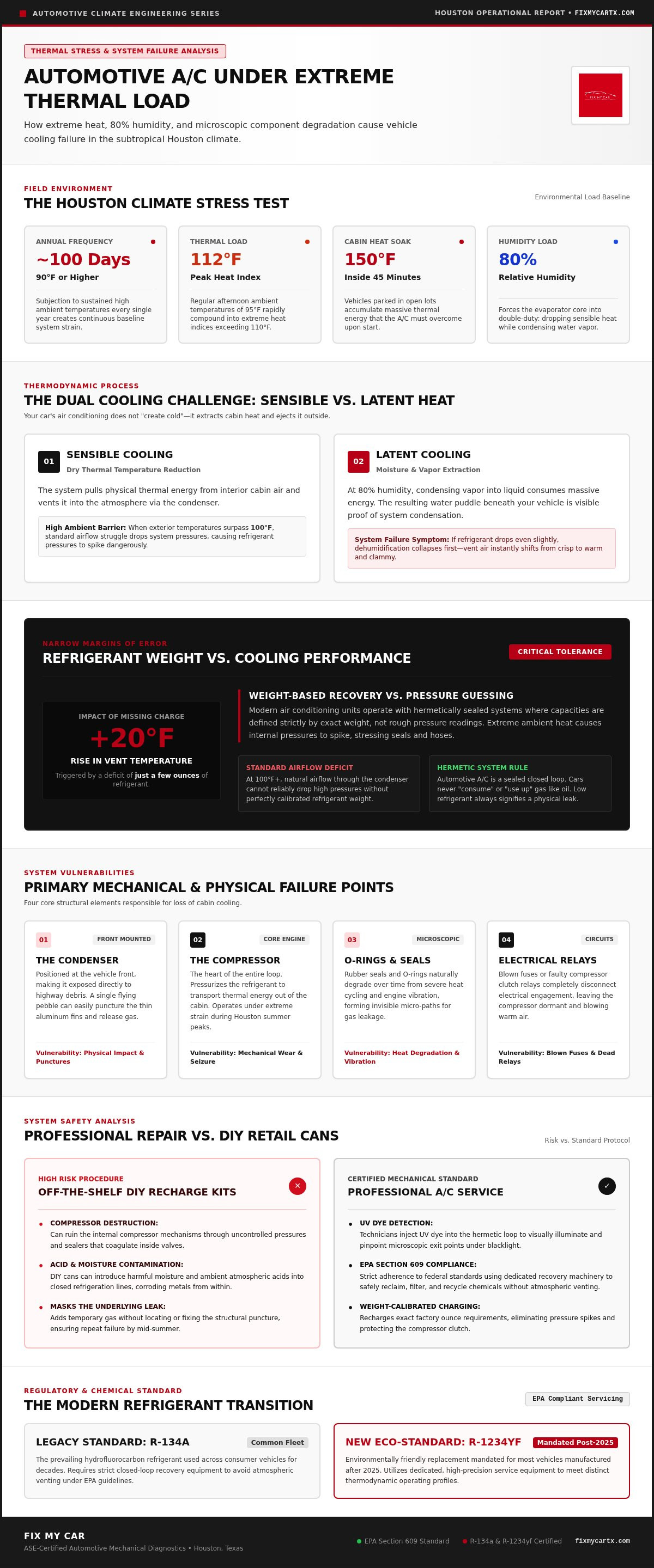
Most drivers think of their dashboard vents as a source of "cold air," but the engineering behind automotive air conditioning systems is actually a heat exchange process. Instead of creating cold, your system pulls thermal energy out of the cabin and dumps it into the outside air. In a city where afternoon temperatures regularly hit 95°F and the heat index climbs toward 112°F, this exchange becomes incredibly difficult. Your car has to work much harder to shed that heat than it would in a drier, cooler climate.
This constant strain is why car air conditioner repair houston isn't just a luxury; it's a technical necessity. Houston commuters face a unique challenge called "heat soak." When your vehicle sits in the sun at a park-and-ride or office lot, interior temperatures can reach 150°F within 45 minutes. Your AC system must overcome this massive thermal load while fighting the external environment. Regular inspections are vital to prevent total compressor failure during a July heatwave.
How Humidity Impacts Your Cooling Performance
Houston's muggy subtropical climate forces your AC to do two jobs at once. First, it lowers the air temperature. Second, it removes moisture. This second task, known as latent cooling, consumes a massive amount of energy. When the air is thick with 80% humidity, the evaporator core works twice as hard to condense that water vapor into liquid. If you see a large puddle under your car after a drive, that's just the system "sweating" as it pulls water out of your cabin. However, if the refrigerant level drops even slightly, the system loses its ability to dehumidify, leaving you with air that feels warm and clammy.
Why "Beating the Heat" Requires Professional Grade Equipment
When outside temperatures exceed 100 degrees, standard airflow through your condenser often isn't enough to drop system pressures to safe levels. High ambient heat causes refrigerant pressures to spike, which can stress seals and hoses. Precision is the only way to combat this. Professional recovery machines allow us to measure refrigerant by weight rather than just pressure, ensuring the system operates exactly as the manufacturer intended. Refrigerant capacity is the specific, narrow margin of error for modern systems where even a few ounces of missing gas can result in a 20 degree rise in vent temperatures. Specialized car air conditioner repair houston ensures your vehicle is prepared for these extreme thermal loads.
Common Culprits: Why Your Car’s AC Stops Blowing Cold
Finding the root cause of a cooling failure is the first step toward a comfortable commute. The condenser sits at the front of your car, making it a primary target for road debris. A single pebble can puncture the aluminum fins, causing a leak that requires professional car air conditioner repair houston to resolve. While the condenser is the most exposed, the compressor is the most critical. As the heart of the system, it pressurizes the refrigerant to move heat out of the cabin. Electrical issues, like a blown fuse or a faulty relay, can also prevent the compressor clutch from engaging, leaving you with nothing but warm air.
Minor components often cause major headaches. O-rings and rubber seals naturally degrade over time due to heat and vibration, creating microscopic paths for refrigerant to escape. Because these leaks are often invisible to the naked eye, they can be difficult for a car owner to diagnose without the right equipment. If you notice your vents aren't as cold as they used to be, a quick check of your car air conditioner repair houston options can help you catch these small issues before they damage your compressor.
Refrigerant Leaks: The Silent Performance Killer
It's a common misconception that cars simply "use up" refrigerant like they do fuel or oil. In reality, automotive AC systems are hermetically sealed loops. If you're low on gas, you have a leak. Modern vehicles typically use either R-134a or the newer, eco-friendly R-1234yf, which is mandated for most vehicles manufactured after 2025. Because these gases are invisible, technicians often inject a UV dye into the system to locate microscopic exit points. Handling these chemicals requires strict adherence to EPA Section 609 servicing regulations, which ensure that refrigerants are recovered and recycled safely rather than vented into the atmosphere.
Mechanical Failures: From Compressors to Blend Doors
Beyond leaks, mechanical issues can be catastrophic. The term "black death" refers to a compressor that has disintegrated internally, spreading metallic debris and sludge throughout the entire system. This requires a full system flush and component replacement to prevent a new compressor from failing immediately. Sometimes the issue is simpler but just as frustrating, such as a faulty blend door. If your driver's side is cool but the passenger side is hot, a stuck door in your dashboard is likely the culprit. Even a clogged cabin air filter can restrict airflow so much that the evaporator freezes over, blocking all cooling performance.
Professional AC Repair vs. DIY Recharge Kits
It's tempting to grab an "all-in-one" recharge kit from a big-box store when your vents start blowing warm air. These cans promise a quick fix for a fraction of the cost of a shop visit. However, these products often cause more harm than good for vehicles requiring car air conditioner repair houston. A retail can only provides a gauge for the low-pressure side of the system, leaving you completely blind to what's happening on the high-pressure side. Without seeing both pressures simultaneously, you're essentially guessing about the health of a high-precision machine.
Professional manifold gauge sets provide a complete picture of system performance. When you use a DIY kit, you might be adding refrigerant to a system that actually has a mechanical blockage or an electrical fault. This leads to overfilling, which is just as damaging as being low. Many retail cans also contain stop-leak additives. These chemicals are designed to swell rubber seals, but they frequently harden into a thick sludge that clogs expansion valves and ruins expensive shop recovery equipment. A botched DIY attempt often turns a simple seal replacement into a multi-thousand dollar system overhaul.
The Risk of System Overpressurization
Modern vehicles use variable displacement compressors that are highly sensitive to precise refrigerant weights. If you overcharge the system, the compressor can "slug," which happens when it attempts to compress liquid instead of gas. This leads to instant mechanical destruction. Professional car air conditioner repair houston involves a critical process called evacuation. We use a high-powered vacuum pump to lower the internal pressure until any moisture inside boils away at room temperature. This is the only way to prevent moisture from reacting with R-134a or R-1234yf to create hydrofluoric acid, which eats your aluminum components from the inside out. Following Department of Energy guidance on hot weather driving, keeping your system properly maintained ensures it can handle the massive thermal loads of a Texas summer without failing.
Accuracy and Environmental Compliance
Beyond the mechanical risks, there are legal and environmental factors to consider. Under EPA Section 609, it's illegal to knowingly vent refrigerants into the atmosphere. DIY kits often lead to accidental venting because they lack the closed-loop recovery systems found in professional shops. Our ASE-certified technicians use specialized machines to recover, clean, and recycle your refrigerant. This process ensures that no harmful gases escape while guaranteeing that your system is recharged with the exact weight specified by the manufacturer, down to the ounce. This meticulous care protects both your vehicle's longevity and the local environment.
The Diagnostic Process: How We Pinpoint AC Issues
Transparency is the foundation of our service. We believe you deserve to know exactly why your vehicle isn't cooling properly before any work begins. Our diagnostic workflow for car air conditioner repair houston follows a meticulous process to ensure we find the root cause, not just the symptom. We don't guess; we use precision tools to verify every component's health.
Visual Inspection: We examine the compressor drive belts for proper tension and wear. We also check hoses for oily residue, which often indicates a slow leak, and clear road debris from the condenser face to ensure maximum airflow.
Performance Testing: Our technicians measure discharge temperatures at the center vents while the system is under load. A healthy, properly charged system should output air between 35°F and 45°F.
Manifold Gauge Analysis: We connect professional gauges to both high and low-side ports. This allows us to evaluate compressor displacement and expansion valve function in real time.
Leak Detection: If pressures are low, we use electronic halogen sniffers or inject UV dye to trace microscopic exit points that are invisible to the naked eye.
Vacuum Decay Testing: Before recharging, we pull the system into a deep vacuum. This confirms the system is hermetically sealed and can hold a charge without leaking.
Advanced Computerized Diagnostics
Modern climate systems are more digital than mechanical. Our technicians scan the Climate Control Module for hidden fault codes that might indicate a failed actuator or a communication error. We monitor real-time data from ambient air and evaporator temperature sensors to ensure the vehicle's computer isn't prematurely cycling the compressor. For a deeper look at how we handle complex vehicle systems, you can explore our guide on Expert Mechanical Repair in Houston TX. This high-tech approach ensures we fix the problem correctly the first time.
The Importance of a Full System Evacuation
Simply "topping off" a system with R-134a or R-1234yf is a temporary band-aid that often masks deeper issues. A professional repair requires a full evacuation to remove old, contaminated oil and atmospheric moisture. Moisture is the enemy of your AC. It reacts with refrigerant to form acids that destroy internal aluminum components. Once the system is clean and dry, we perform a precision recharge. Professional charging is measured in ounces by weight, not just by pressure on a gauge, which ensures the exact thermal capacity your car needs to fight the Texas sun. If your vents are blowing warm air, schedule a professional AC diagnostic today to get an honest, transparent assessment of your system's health.
Reliable AC and Mechanical Repair at Fix My Car Houston
Fix My Car stands as the authoritative guide for North Houston drivers who refuse to compromise on their comfort. We've built our reputation on a foundation of professional authority and warm, local hospitality. When you choose us for car air conditioner repair houston, you aren't just getting a technician; you're gaining a partner invested in your vehicle's long-term reliability. Our North Houston facility in the 77091 area is designed to provide a high-stakes technical environment that still feels like visiting a trusted neighbor.
Meticulous attention to detail defines our approach. Every ASE-certified technician on our team understands that a successful AC repair requires more than just a quick recharge. It demands a deep understanding of thermal dynamics and mechanical precision. To ensure you feel completely confident in our process, we provide free estimates that offer a transparent breakdown of every necessary step. We believe in reducing the stress of auto repair through honesty and clear communication, treating every guest with the respect they deserve.
We know your schedule is demanding. Leaving your car at a shop shouldn't derail your entire afternoon. That's why we offer complimentary ride-share services to keep you moving while we focus on restoring your ice-cold air. This commitment to convenience is part of our goal to make professional car air conditioner repair houston as effortless as possible for our community.
Expertise Beyond the Vents: Collision and Mechanical Synergy
Our background in collision repair north houston gives us a unique advantage when diagnosing cooling issues. Because the condenser is the most vulnerable part of the AC system, even a minor front-end impact can compromise its performance. We use high-quality parts designed to withstand the brutal Texas heat, ensuring your repair lasts through the peak of August. If you've recently been in an accident that's affecting your cooling, we recommend starting with a Free Collision Repair Estimate Houston to ensure both your bodywork and your AC system are restored to factory standards.
A Community-Focused Experience
Choosing a local shop means choosing a team that understands exactly what you're facing on the 610 Loop or I-45. We take immense pride in our craft, maintaining the rigorous standards required of an I-CAR Gold Class body shop Houston. This level of certification is rare and reflects our dedication to modern innovation and traditional service values. You can rest easy knowing your vehicle is in the hands of professionals who prioritize your safety and peace of mind above all else.
Reclaim Your Comfort on Houston Roads
Driving through a Texas summer doesn't have to be a test of endurance. We've explored how local humidity strains your vehicle's evaporator and why retail recharge cans often lead to costly mechanical failures. True reliability comes from a meticulous diagnostic process that identifies microscopic leaks and ensures your system is charged with the exact weight of refrigerant it needs. Our ASE-certified technicians are here to provide the precise care your vehicle requires to stay ice-cold through the peak of August.
At Fix My Car, we combine North Houston local expertise with a commitment to transparency. Whether you need a simple seal replacement or a complex compressor restoration, we make the process effortless with free estimates and complimentary ride-share perks. Don't spend another afternoon suffering in the heat when expert car air conditioner repair houston is just a click away. We're ready to help you get back on the road with total peace of mind and a cabin that feels like a sanctuary.
Book Your Free AC Estimate at Fix My Car Today
Frequently Asked Questions
Why is my car AC blowing cold on one side and hot on the other?
This issue is usually caused by a failed blend door actuator or a low refrigerant charge. In modern dual-zone systems, the vehicle's computer uses small motors to mix air to your desired temperature. If one side stays hot, that specific door is likely stuck. However, an uneven charge of R-134a or R-1234yf can also cause temperature variances across the evaporator core. Our technicians use computerized scanning to verify actuator function before recommending a repair.
How often should I have my car AC system inspected in Houston?
We recommend a professional inspection at least once a year, preferably in early spring before the 90°F days arrive. Houston's high humidity and extreme heat index put immense strain on your condenser and compressor. A seasonal check ensures your refrigerant levels are precise and your cabin filter is clear of debris. Catching small leaks early prevents the catastrophic compressor failures that often happen during peak Texas heatwaves.
Can a car accident cause my AC to stop working even if the bumper looks fine?
Yes, front-end impacts often cause hairline fractures in the aluminum lines or the condenser located behind the bumper cover. Since the condenser sits directly behind the grille, it absorbs much of the energy in minor collisions. Even if the exterior looks intact, a slow leak can develop over several weeks. As an I-CAR Gold Class body shop, we specialize in identifying post-collision cooling issues that standard mechanical shops might miss.
What is the difference between an AC recharge and an AC repair?
A recharge is simply adding refrigerant, while a repair addresses the leak or mechanical failure that caused the loss in the first place. Recharging a leaking system is a temporary fix that wastes money and harms the environment. Professional car air conditioner repair houston involves finding the leak, replacing the failed seal or component, and then performing a deep vacuum before recharging the system to factory specifications for long-term reliability.
Is it safe to drive my car if the AC compressor is making a loud noise?
It's generally not recommended to keep running the AC if you hear grinding or squealing from under the hood. A noisy compressor often indicates a failing bearing or internal mechanical disintegration. If the compressor seizes, it can snap your serpentine belt, which may leave you stranded by disabling your alternator and power steering. We suggest turning the AC off and visiting our North Houston shop to prevent a minor noise from becoming a major breakdown.
How long does a typical car air conditioner repair take in Houston?
A standard diagnostic and recharge usually takes a few hours, while major component replacements like an evaporator or compressor may require a full day. The timeline depends on the complexity of the leak and the accessibility of the parts. We offer complimentary ride-share transportation to keep your day moving while our ASE-certified technicians work. We'll provide a clear time estimate along with your free estimate during the initial inspection process.
What are the signs that my cabin air filter needs to be replaced?
Reduced airflow from your vents and a musty smell are the most common indicators of a clogged filter. In Houston, pollen and dust can quickly saturate the filter, forcing your blower motor to work harder and reducing cooling efficiency. If you notice your windows are fogging up more often or the fan sounds louder but pushes less air, it's time for a change. Replacing this filter is a simple way to improve air quality.
Why does my car AC smell like vinegar or mold when I first turn it on?
This odor is caused by bacteria and mold growing on the damp evaporator core inside your dashboard. Because your AC removes so much humidity, moisture often lingers in the dark evaporator housing after you park. We can perform a professional sanitization service to clean the core and eliminate the smell. To prevent this, try turning off your AC but leaving the fan running for the last minute of your drive to dry the system.


Comentarios