


Automotive AC Recharge Houston: Beating the Texas Heat
Automotive refrigerant doesn't expire, burn off, or wear out like engine oil. If you find yourself searching for an automotive AC recharge houston drivers count on, your vehicle doesn't simply need a blind top-off; it has lost pressure through a physical leak. Crawling through Houston traffic along I-45 when the heat index climbs past 105 degrees is miserable enough without warm, clammy air blowing directly into your cabin. You shouldn't have to suffer through unbearable commutes, nor should you waste money charging a system only to have the gas escape within days.
In this guide, you will discover how a professional evacuate-and-recharge cycle works, why retail aerosol cans often cause severe compressor damage, and how to verify which refrigerant your vehicle actually requires. We will break down the mechanical differences between a simple refill and full deep-vacuum evacuation, helping you locate underlying leaks and restore dependable, ice-cold airflow before peak Gulf Coast summer heat sets in.
Table of Contents
What Is an Automotive AC Recharge and When Does Your Vehicle Need One?
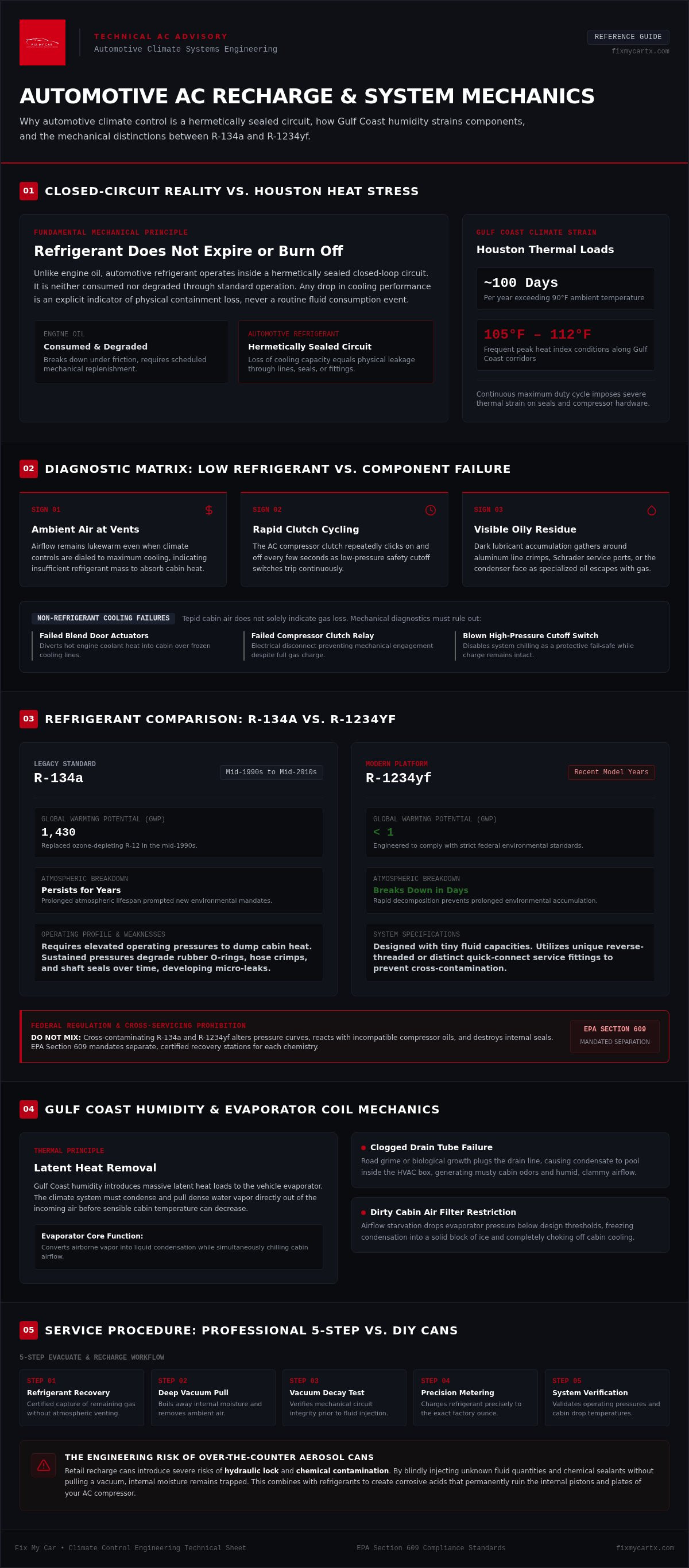
A complete automotive AC recharge is not a simple fluid top-off. It is a closed-loop procedure that involves recovering remaining gas, creating a deep vacuum to boil away internal moisture, testing for leaks, and refilling the system with precise refrigerant weight. Your car's air conditioning circuit is hermetically sealed at the factory. It operates much like your home refrigerator; it does not consume, burn, or evaporate refrigerant during normal operation. When cold air fades, you are dealing with a loss of containment.
Tepid air doesn't automatically mean you are low on refrigerant. Failed blend door actuators can direct hot engine coolant heat into the cabin even when cooling lines freeze over. Similarly, a failed compressor clutch relay or a blown high-pressure cutoff switch can disable chilling completely while keeping refrigerant levels intact. True diagnostics separate electrical switch failures from physical gas loss before anyone hooks up an evacuation machine.
Scheduling a thorough automotive AC recharge houston drivers trust becomes essential because our subtropical climate subjects climate systems to continuous maximum duty. With nearly 100 days per year exceeding 90°F and heat indexes frequently hitting 105°F to 112°F, cooling components face severe thermal strain daily.
Signs Your Car AC System Is Low on Refrigerant
Refrigerant carries the specialized lubricant that keeps your compressor alive. When containment fails, watch for these operational red flags:
Vents blowing ambient air: Airflow stays lukewarm even when you set climate controls to maximum cooling.
Rapid clutch cycling: The AC compressor clutch clicks on and off every few seconds as low-pressure safety switches trip repeatedly.
Visible oily residue: Dark oil accumulation gathers around aluminum line crimps, Schrader service ports, or the condenser face.
The Impact of Houston Humidity on Vehicle Climate Control
Gulf Coast humidity adds massive latent heat loads to your vehicle's evaporator coil. The system must pull dense water vapor out of the air before it can drop sensible cabin temperatures. If an evaporator drain tube clogs with road grime or biological growth, water pools inside the HVAC box, creating musty odors and clammy air. Additionally, a dirty cabin air filter starves the core of airflow. This restriction drops evaporator pressure, freezes ambient condensation into a solid block of ice, and chokes off cool airflow completely during brutal summer highway drives.
Modern Refrigerant Standards: Comparing R-134a and R-1234yf Systems
Automotive cooling technology has transformed dramatically over the past few decades. The industry phased out ozone-depleting R-12 in the mid-1990s, replacing it with R-134a. While R-134a proved harmless to the ozone layer, its global warming potential (GWP) of 1,430 prompted federal environmental standards to demand an alternative. That shift brought R-1234yf, a modern refrigerant carrying a GWP under 1 that breaks down in the atmosphere within days instead of years.
You cannot mix these two refrigerants. Cross-contaminating systems alters internal pressure curves, reacts with the wrong compressor oils, and quickly destroys internal seals. Because these gases behave differently under pressure, federal EPA Section 609 regulations mandate that repair facilities use separate, certified recovery machines for each fluid. This strict standard prevents cross-gas mixing and keeps harmful venting out of the atmosphere. If you are scheduling an automotive AC recharge houston drivers rely on for newer platforms, ensuring your shop uses dedicated recovery stations protects your investment.
R-134a Refrigerant in Older and Classic Vehicles
Most vehicles built before the mid-2010s rely entirely on R-134a. This gas requires elevated operating pressures to dump cabin heat through the front condenser during sweltering Texas summers. Over time, those sustained high pressures degrade rubber O-rings, hose crimps, and shaft seals. Once these flexible seals dry out, micro-leaks develop, causing slow refrigerant loss that gradually cuts into cooling capacity.
R-1234yf Systems in Newer Cars, Trucks, and SUVs
Virtually all light-duty vehicles produced for recent model years run on R-1234yf. To prevent accidental cross-servicing, manufacturers engineer these systems with unique, reverse-threaded or distinct quick-connect service fittings. Because modern circuits hold tiny fluid capacities, servicing R-1234yf demands certified equipment equipped with integrated refrigerant identifiers and spark-proof fans, alongside technicians trained on precise weigh-in protocols.
Professional AC Recharge vs. DIY Cans: Protecting Your Compressor
Grabbing an over-the-counter refrigerant canister from an auto parts store seems like an easy Saturday fix. In practice, it represents one of the quickest ways to destroy an automotive cooling system. Retail cans rely on crude, color-coded low-side pressure gauges that provide an incomplete picture of circuit dynamics. Modern passenger vehicles hold surprisingly small refrigerant capacities, often between 12 and 20 ounces total. Adding just 1 or 2 extra ounces can spike internal pressures, cutting cooling performance by 15% to 25% or triggering emergency high-pressure shutoffs.
DIY cans connect exclusively to the low-pressure service port. If an internal expansion valve or orifice tube suffers a partial clog, suction pressure stays deceptively low while high-side pressure skyrockets to dangerous levels. Shaking or tilting an aerosol can introduces raw liquid refrigerant directly into the compressor suction port. Because liquids cannot be compressed, this causes instant hydraulic lock, shattering internal pistons and reeds. Investing in a professional automotive AC recharge houston drivers rely on ensures refrigerant is metered strictly by weight rather than estimated by an uncalibrated hand gauge.
The Hidden Risks of Chemical Stop-Leak Additives
Most retail aerosol canisters contain chemical sealants formulated to swell rubber gaskets. When these compounds encounter atmospheric air and moisture inside a compromised circuit, they chemically react and harden. This gummy residue quickly plugs tiny condenser micro-channels and freezes precision expansion valves. Once introduced, these sealers circulate continuously. They contaminate professional recovery machinery, forcing repair facilities to test systems for chemical contaminants before connecting shop equipment.
Why Controlled Vacuum Evacuation Is Non-Negotiable
Professional service machines pull a deep mechanical vacuum (29 to 30 inHg) for at least 15 to 30 minutes before charging. Lowering ambient pressure inside the circuit boils away trapped moisture vapor at room temperature. Skipping this critical dehydration stage leaves atmospheric water trapped inside. Moisture reacts chemically with circulating PAG or POE compressor oils, generating hydrochloric and hydrofluoric acids that strip internal plating, corrode aluminum lines, and cause premature bearing failure.
The 5-Step Professional Automotive AC Recharge Process
Professional auto facilities follow a rigorous five-step procedure rather than guessing fluid levels. When technicians perform an automotive AC recharge houston drivers count on, they connect dedicated diagnostic manifolds to both high-pressure and low-pressure ports. Evaluating dynamic pressure differentials while the engine idles reveals whether cooling trouble stems from compressor fatigue, internal blockages, or lost fluid. Once documented, technicians recover remaining gas into sealed tanks to record the exact volume deficit.
Precision defines modern vehicle service. Technicians filter recovered refrigerant, isolate the system under deep vacuum decay tests, and re-meter factory-specified fluids down to the individual gram. Prioritizing timely maintenance protects broader engine health; exploring how broader mechanical repair in Houston TX safeguards your vehicle powertrain from cooling system strain highlights how an overtaxed compressor places heavy drag on your engine drive belt and electrical systems.
Comprehensive Diagnostics and Electronic Leak Detection
Technicians inspect serpentine belts, magnetic clutch engagement gaps, condenser electric cooling fans, and aluminum line crimps. If pressures indicate loss, technicians inject UV fluorescent dye and trace connections using electronic halogen sniffers capable of detecting micro-fractures emitting less than 0.1 ounces of gas per year. Technicians verify mechanical sealing integrity across every joint before authorizing fresh gas injection.
Vacuum Testing and Calibrated Refrigerant Refill
Dedicated recovery units draw the circuit down to 29 to 30 inches of mercury, maintaining this vacuum for 15 minutes to confirm the needle does not drop. Once sealed integrity is confirmed, the unit injects fresh, factory-specified PAG or POE lubricant to replace oil drawn out during recovery. The station then meters pristine refrigerant into the high side by exact weight according to the under-hood factory specification decal.
Final Vent Temperature and System Performance Verification
Technicians insert digital thermistor probes into center dash vents, measuring discharge temperature at simulated highway speeds (around 1,500 to 2,000 engine RPM). Gauges verify that high-side head pressures balance properly against Gulf Coast ambient heat and relative humidity. You can consult our complete buyer guide to staying cool for comprehensive component inspection advice. If your air conditioner blows warm, schedule an AC inspection with our certified team to restore dependable cooling performance.
Reliable Houston AC Service: Staying Cool With Fix My Car
Fix My Car stands as a trusted independent automotive mechanical and collision repair facility in North Houston. Located at 6015 N. Shepherd Dr, our facility delivers thorough air conditioner and heater repair designed to withstand extreme Gulf Coast heat waves. Rather than applying quick surface fixes, our team approaches climate control as an integrated mechanical circuit. When you book an automotive AC recharge houston drivers rely on, our ASE-certified technicians perform comprehensive leak tests before introducing fresh refrigerant, ensuring long-term cooling reliability.
Whether your daily commuter requires classic R-134a or your late-model family SUV features complex R-1234yf plumbing, our shop utilizes dedicated recovery and recharging equipment for each gas. We treat every vehicle owner like a neighbor. You receive clear explanations, honest assessments, and free estimates upfront without confusing upsells. Taking a proactive approach before triple-digit summer afternoon traffic prevents sudden compressor failures and protects your engine from secondary heat stress.
North Houston Mechanical Excellence and Transparent Service
Our bilingual service team provides itemized diagnostic evaluations before turning a single wrench. Backed by advanced scan tools and I-CAR Gold Class facility standards, our technicians service domestic, Asian, and European models to precise factory guidelines. We verify pressure tolerances, check electronic blend doors, and test cooling fans to make sure your climate control system delivers balanced cabin airflow under heavy thermal loads.
Convenient Scheduling and Stress-Free Customer Amenities
Auto maintenance shouldn't disrupt your entire day. To keep your work schedule on track, Fix My Car provides complimentary ride-share transportation throughout Houston while our technicians diagnose and service your vehicle. Our local team understands the daily punishment Gulf Coast highways inflict on passenger cooling circuits. You can schedule your visit today at Fix My Car to restore crisp, ice-cold air conditioning and enjoy complete peace of mind behind the wheel.
Restore Ice-Cold Cabin Comfort Before the Next Heat Wave
Texas summers don't forgive a compromised climate control system. Refrigerant never simply evaporates on its own; losing cold air signals an active leak that demands accurate mechanical diagnosis. Skipping quick-fix aerosol cans protects your compressor from catastrophic hydraulic lock, while a full deep-vacuum evacuation boils off internal moisture to keep your cooling circuit running cleanly under heavy thermal loads.
When you are ready for an automotive AC recharge houston drivers trust for lasting relief, Fix My Car provides complete peace of mind. Our ASE-certified technicians are trained in precision automotive HVAC systems, ensuring every gram of refrigerant and drop of oil matches factory standards. With transparent diagnostics, free estimates, and complimentary ride-share service across Houston while your car is in the shop, staying cool has never been easier.
Restore your ice-cold air today at Fix My Car and take on the Gulf Coast heat with total confidence.
Frequently Asked Questions
How often does a vehicle need an automotive AC recharge in Houston?
A vehicle's climate control system should never require routine recharging unless there is an underlying leak. Automotive climate systems operate as hermetically sealed circuits. You only need an automotive AC recharge houston technicians provide when physical seals, hoses, or fittings degrade and allow gas to escape. Rather than treating recharges as annual maintenance, schedule a diagnostic check whenever vent temperatures rise or cooling performance weakens.
Why is my car AC blowing cool air instead of ice-cold air?
Air blowing cool rather than ice-cold usually indicates a partial refrigerant deficit, poor condenser airflow, or a slipping compressor clutch. When fluid levels drop slightly, the evaporator cannot reach freezing temperatures, leaving cabin air feeling mild. In humid Houston weather, a dirty cabin filter or road debris covering the exterior condenser fins also restricts heat transfer, preventing the system from cooling incoming air completely.
Can I just add refrigerant without fixing an air conditioning leak?
Adding refrigerant without repairing an active leak wastes money and violates federal EPA venting regulations. Escaping gas simply leaks back into the atmosphere, often within days or weeks. Even worse, as refrigerant escapes, lubricating oil escapes with it, leaving the compressor unprotected. To protect your vehicle, a certified technician must pinpoint and seal the breach using vacuum decay testing before replenishing fluids.
How do I know if my vehicle uses R-134a or R-1234yf refrigerant?
You can easily confirm your vehicle's refrigerant type by checking the factory emissions and climate specification sticker under the hood. This label sits on the radiator support panel or inner hood surface. Most passenger cars built before 2015 use R-134a, while newer models overwhelmingly feature R-1234yf. The service charge ports under your hood also feature distinct physical dimensions to prevent technicians from mixing incompatible gases.
What is the danger of using DIY recharge cans from an auto parts store?
Retail cans lack calibrated weight scales and high-pressure monitoring, making it dangerously easy to overfill modern low-capacity systems. Overcharging triggers high-pressure safety cutoffs and ruins compressor valves. Additionally, many DIY formulas contain chemical stop-leak agents that gum up thermal expansion valves, plug condenser micro-channels, and contaminate commercial evacuation machinery. If you tilt or shake the can, liquid refrigerant can cause catastrophic compressor hydraulic lock.
How long does a professional car AC diagnostic and recharge service take?
A comprehensive AC diagnostic and evacuation service generally takes about 60 to 90 minutes. Technicians spend initial time running pressure checks and electronic leak detection. Then, the recovery machine requires 15 to 30 minutes to boil away internal moisture under a deep vacuum before metering in fresh oil and refrigerant. At Fix My Car, our complimentary ride-share service ensures you stay on schedule while our technicians handle testing.
Does low refrigerant cause permanent damage to my car AC compressor?
Yes, running your air conditioner with low refrigerant can permanently ruin your compressor. Specialized lubricating oil travels suspended inside the refrigerant stream to lubricate the compressor's internal pistons and bearings. When refrigerant escapes, lubricant circulation drops, generating excessive friction and heat. Over time, internal parts seize or shed fine metal shrapnel throughout your cooling lines, necessitating a complete, complex system flush and component replacement.


Comentarios